Why most training doesn't stick (and what science says about it)


You sit through a full-day training workshop on Monday and forget most of it by Friday.
You spend an hour clicking through a module and then can't recall a single key point when it matters.
You read an entire training manual and then struggle to apply any of it on the job.
Sound familiar?
Well, you’re not alone. And it’s not a reflection of your effort or intelligence. It's just how human memory works.
The uncomfortable truth is that most workplace training is designed around what's convenient to deliver, not around how people actually learn. And there's a 130-year-old piece of research that makes this pretty hard to ignore.
Enter the forgetting curve
In the 1880s, German psychologist Hermann Ebbinghaus ran a series of experiments on memory. What he found was striking. Without any reinforcement, people forget roughly 50% of new information within a day. Within a week, that can climb to around 90%.
He called this the forgetting curve, and while the exact numbers vary depending on the individual and the material, the pattern is consistent: memory decays fast, and it decays predictably.
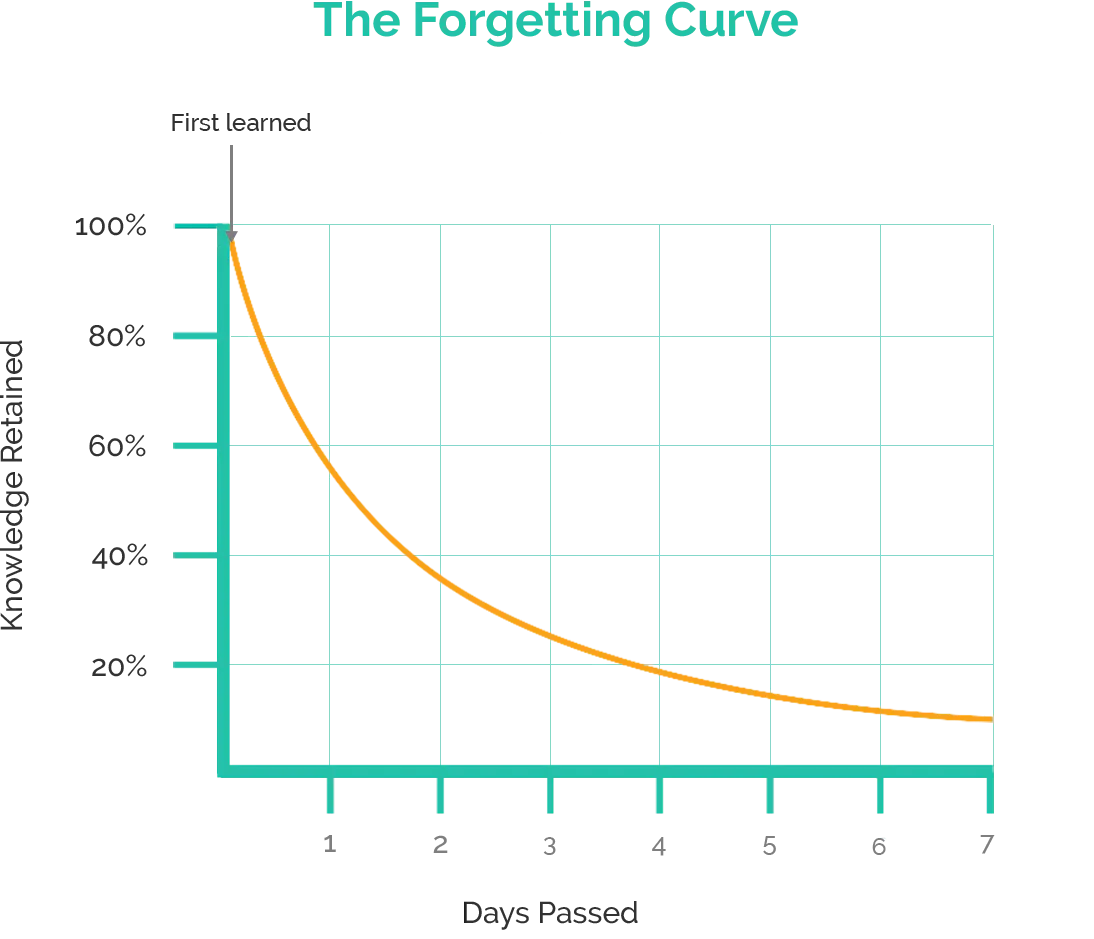
This isn't a new finding. It's been replicated many times over. Yet most workplace training still follows the same format: gather everyone in a room (or a Zoom call), deliver the content, and move on.
The problem with "one and done"
Think about the last training session your team completed. Whether it was a compliance module, a product update, or a sales skills workshop, how much do you think they retained a week later?
If the answer is "not much," you're not alone, and you're not failing at L&D. You're just running into a biological reality that a single training event, no matter how good, can't overcome on its own.
The brain doesn't store information permanently after one exposure. It needs repetition, and specifically, it needs repetition spaced out over time.
So what does this mean in practice?
Understanding the forgetting curve changes how you think about training design. The goal shifts from "how do we deliver this content?" to "how do we make sure this content actually sticks?"
That might mean following up a workshop with reinforcement activities in the days and weeks after. It might mean shorter, more frequent learning moments instead of one long session. It might mean building in ways for people to actively retrieve what they've learned, rather than just re-reading or re-watching material.
These aren't complicated ideas. They're just not how most training is built.
At Yarno, this is the problem we set out to solve. Our platform is built around the science of how memory actually works, delivering bite-sized questions to your team at spaced intervals to reinforce learning over time, not just in the moment.
Training that ‘controls the curve’
The forgetting curve isn't a reason to give up on training. It's a reason to rethink how training is designed.
It means thinking about learning as something that happens over days and weeks, not in a single session. Small, repeated moments that bring people back to the material and ask them to actively engage with it. That's a harder thing to do manually, but it's exactly what the right tools can take off your plate.
That's the thinking behind Yarno. If you're curious about how it works in practice, we'd love to show you.