Spaced repetition: the simplest thing you're probably not doing
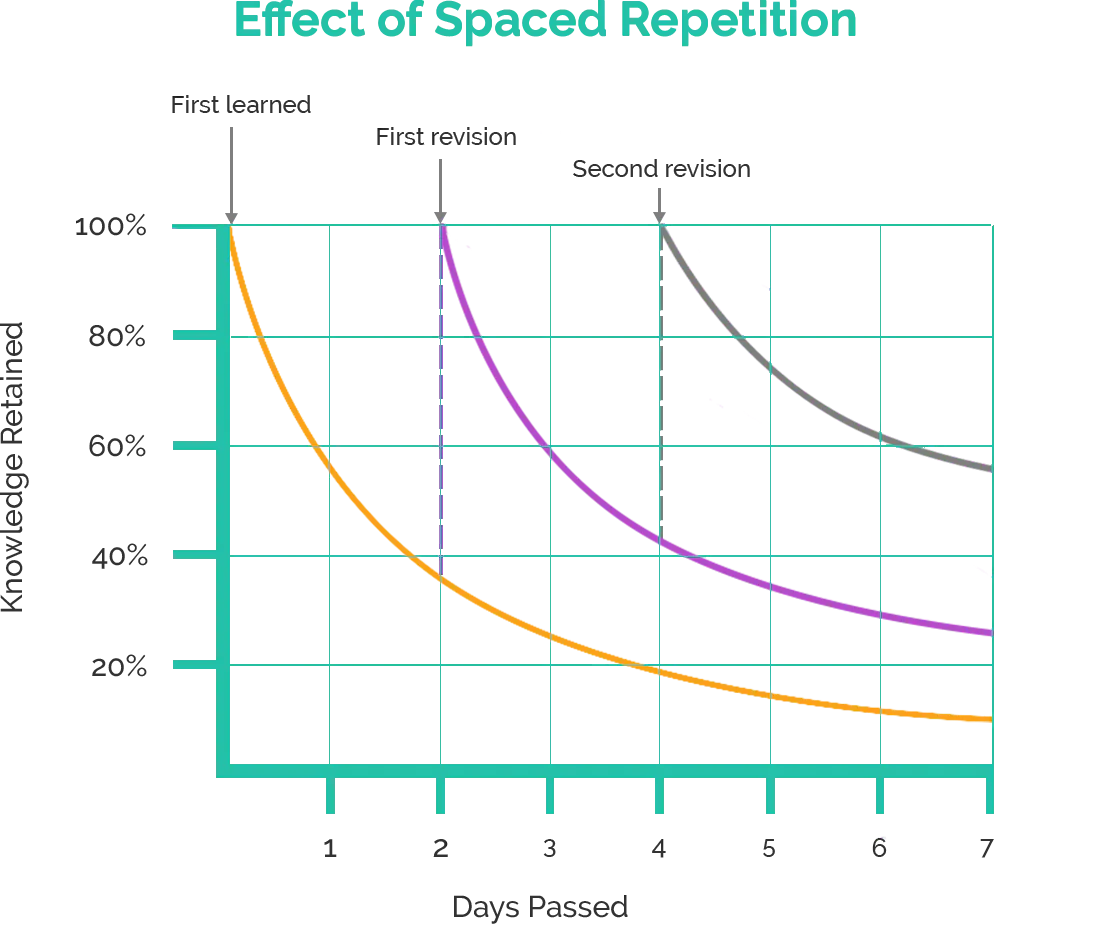
What if the biggest lever in learning had nothing to do with your content and everything to do with your timing?
That's the idea behind spaced repetition, and once you understand it, it changes how you look at almost every training program you've ever run.
What is spaced repetition?
Spaced repetition is the practice of returning to material repeatedly, at increasing intervals over time, rather than covering it once and moving on.
So rather than a three-hour training block on Tuesday, you might have a short session on Tuesday, a follow-up on Thursday, another touchpoint the following week and a final one a few weeks after that. Same material, same total time, very different outcome.
The reason it works comes down to how memory is formed. Every time you retrieve a piece of information, you strengthen the neural pathway connected to it. Leave it too long and that pathway weakens. Come back at the right moment, just before you'd typically forget it, and you reinforce it at exactly the point it counts.
What the research says
This isn't a new idea. Memory researchers have been studying distributed practice for decades, and the evidence is consistent.
A 2022 paper in Nature Reviews Psychology by Carpenter, Pan and Butler found strong evidence that spacing and retrieval practice are among the most effective learning strategies available. Michael Jacob Kahana's work in Foundations of Human Memory reaches similar conclusions, showing that the timing of repetition matters as much as the repetition itself.
Spaced repetition and active recall
Spaced repetition works even better when it's paired with active recall, which is the practice of retrieving information from memory rather than passively re-reading or re-watching it.
The difference matters. Reading through your notes feels productive, but it's a passive experience. Your brain recognises the information without having to work for it. Active recall flips that. It forces your brain to search for the answer, and that effort is what makes the memory stronger.
A study by Rawson and Dunlosky (2011) shows that retrieval practice improves long-term retention far more than passive review. A 2018 meta-analysis by Pan and Rickard covering a wide body of spaced retrieval research found strong, consistent benefits for memory retention across different contexts and subjects. In practical terms, a short quiz two days after a training session will do more for retention than re-watching the same session.
What this looks like at work
For L&D teams, this is where things get practical. Most training is already designed with good content. The gap is usually in what happens after.
A few ways to build spaced repetition into your learning programs:
- Follow up workshops with a short quiz or activity a few days later, then again a week or two after that
- Replace long annual compliance refreshers with shorter, more frequent touchpoints throughout the year
- Use brief scenario-based questions to bring people back to key concepts, rather than asking them to re-read a document
None of this requires rebuilding your entire training program. It's just a case of shifting when and how often people engage with learning material.
How Yarno makes spaced repetition easy
Most training platforms are built around content delivery. Yarno is built around what happens after.
Once your training is live, Yarno serves short questions to your learners at regular intervals, bringing them back to the material and asking them to actively recall it rather than just re-read it. Admins stay in control of when campaigns go out, and the format does the hard work of keeping learners engaged and coming back over time.
It's a practical way to build spaced repetition and active recall into your learning programs, without having to redesign everything from scratch. Ready to build it into your training? Get started with Yarno.