Why your learning program is losing the attention war (and how to win it back)

Quick question before we start: how many tabs do you have open right now?
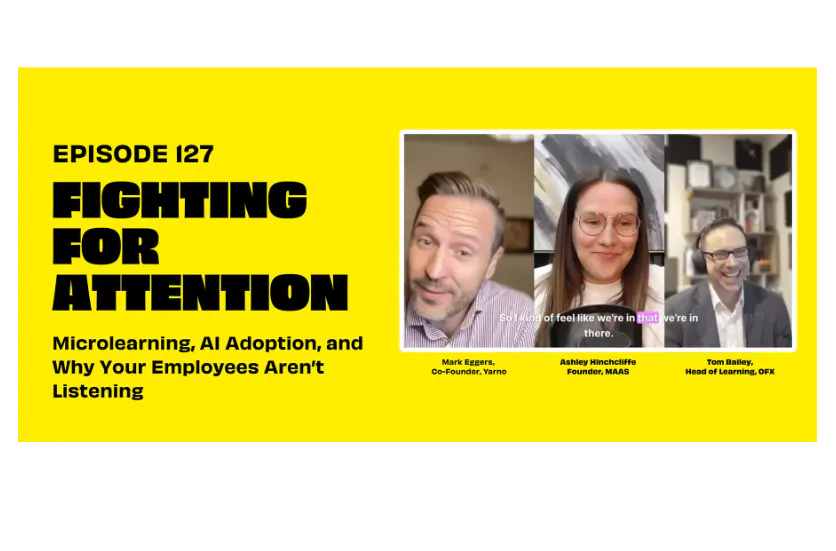
If the answer made you wince a little, you already understand the problem our co-founder Mark Eggers tackled on a recent episode of the Marketing for Learning podcast. Its host, AshleyHinchcliffe, sat down with Mark and Tom Bailey (Previously Head of Learning at OFX, host of the Rogue L&D podcast and L&D Professional of the Year 2025) to unpack why good learning so often goes unnoticed, and what to do about it. Here are the five things to win back your learners' attention.
1. Attention is the scarcest resource at work
Researchers have clocked the average attention window at about 40 seconds. Knowledge workers face somewhere between 60 and 120 interruptions a day and switch between apps more than 1,200 times. None of that counts the phone sitting face-down on the desk (we see you).
So when a 45-minute module lands in someone’s inbox, it’s not competing with apathy. It’s competing with everything else. The question for L&D isn’t “how do we make people care?” It’s “how do we fit into the gaps they actually have?”
2. AI is the new vacuum cleaner
When the vacuum cleaner arrived, nobody got their Saturdays back. Instead, as Mark puts it, slightly dusty floors became socially unacceptable overnight. Historian Ruth Schwartz Cowan found the same pattern across the whole 20th-century home in More Work for Mother: new labour-saving appliances raised the standard of “clean” and kept the hours spent cleaning much the same.
Mark reckons AI is doing the same to work. He shared a real example from Yarno: a task that used to take an hour now takes ten minutes. Brilliant, right? Except the bar has quietly moved, and those 50 minutes have already been filled with more work.
Tom compared it to the arrival of the personal computer: a genuine leap forward that also left everyone scrambling to keep up. We’re somewhere in the messy middle of that curve now, and it’s tiring. Learning that respects people’s mental bandwidth matters more than ever.
3. Short, sharp and spaced beats long and linear
This is the bit where Mark gets to talk about why Yarno exists. The platform was built out of frustration with “click next” learning, and leans on a few well-tested ideas from cognitive science: retrieval practice (quizzing beats rereading), spacing (little and often beats all at once) and a dash of game mechanics to keep things lively.
The result is participation rates north of 90%, even on content nobody would describe as thrilling. Tom added an important caveat from the practitioner’s chair: the format only gets you so far. Sales teams, operations teams and head office all respond to different hooks, so the motivation has to be designed in, not bolted on.
4. If you build it, they won’t necessarily come
Tom’s view is simple: marketing is part of L&D, not an optional extra. Plenty of great programs launch with a single “we’re excited to announce” email and then wonder why the numbers are flat.
The fix is old-school marketing thinking. The AIDA model (awareness, interest, desire, action) is a handy check. Most internal comms leap straight to action (“enrol now!”) without first giving people a reason to notice, care or want in. Build the story before you ask for the click.
5. L&D has a licence to experiment, so use it
Here’s the encouraging part. L&D teams have something many functions would envy: room to try things, learn quickly and adjust without anything catching fire. Run the pilot. Measure what moves. Then take the results to the business.
Waiting for permission rarely works, because the business may not see the attention problem clearly yet. Showing them what’s possible is one of the most valuable things L&D can do.
Worth a listen
If you’ve ever poured your heart into a learning program and watched it sink without a trace, this episode is a reassuring (and practical) hour well spent. Pop it on for your next commute and see how many of those 1,200 app toggles you can skip.
And if you’d like to see what quiz-first, spaced learning looks like when people actually want to take part, we’d love to show you. Book a Yarno demo